
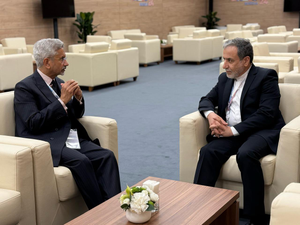
New Delhi, March 5 (IANS) External Affairs Minister (EAM) S Jaishankar held a telephonic conversation with his Iranian counterpart Seyed Abbas Araghchi for the second time in less than a week on Thursday, discussing the evolving security situation in West Asia.
Following their conversation, EAM Jaishankar wrote on X, "Had a telecon with Iranian FM Seyed Abbas Araghchi this afternoon."
EAM Jaishankar last spoke with Araghchi on February 28, expressing India's concerns at the recent developments in Iran and the region.
"Had a telecon with Iranian FM Seyed Abbas Araghchi this evening. Shared India’s deep concern at the recent developments in Iran and the region," EAM Jaishankar posted on X.
Earlier on Thursday, Foreign Secretary Vikram Misri, on behalf of the Government of India, signed the condolence book at the Iranian Embassy in New Delhi and offered condolences on the death of Iran's Supreme Leader Ayatollah Ali Khamenei.
On Tuesday, India expressed concern over the commencement of the conflict in Iran and the Gulf region and reiterated its call for dialogue and diplomacy. India called for early end to the conflict as many lives have been lost.
In an official statement, the Ministry of External Affairs (MEA) stated, "We had expressed our deep concern at the commencement of the conflict in Iran and the Gulf region on 28 February 2026. Even at that time, India had urged all sides to exercise restraint, avoid escalation and prioritize the safety of civilians. Unfortunately, in the holy month of Ramadan, the situation in the region has deteriorated significantly and continuously.
"In recent days, we have not only witnessed an intensification of the conflict but also its spread to other nations. The destruction and deaths have mounted, even as normal life and economic activities come to a halt. As a proximate neighbour with critical stakes in the security and stability of the region, these developments evoke great anxiety," it added.
According to the MEA statement, Safety and well being of around one crore Indian citizens who live and work in the Gulf region remains Indian government's utmost priority. Indian government will continue to closely monitor the evolving situation and take relevant decisions in the national interest.
"We cannot be impervious to any development that negatively affects them. Our trade and energy supply chains also traverse this geography. Any major disruption has serious consequences for the Indian economy. As a country whose nationals are prominent in the global workforce, India is also firmly opposed to attacks on merchant shipping. Already, some Indian nationals have lost their lives or are missing as a result of such attacks in the last few days."
The MEA stated that Indian Embassies and Consulates in the affected countries remain in close touch with Indian nationals and community organisations and have been issuing regular advisories and extending all possible help to thse stranded by the conflict.
The conflict in West Asia was triggered by the joint US-Israel strikes against Iran on February 28, aimed at degrading Tehran's missile capabilities and military infrastructure. The opening wave of the operation killed senior figures in the Iranian leadership, including Supreme Leader Ayatollah Ali Khamenei, triggering a response from Tehran in the form of drone and missile attacks targetting US assets, regional capitals and allied forces across the region
Iran's retaliatory strikes have spanned several countries, with missiles and drones intercepted over Kuwait, Bahrain and the United Arab Emirates, prompting temporary airspace closures.
--IANS
akl/as